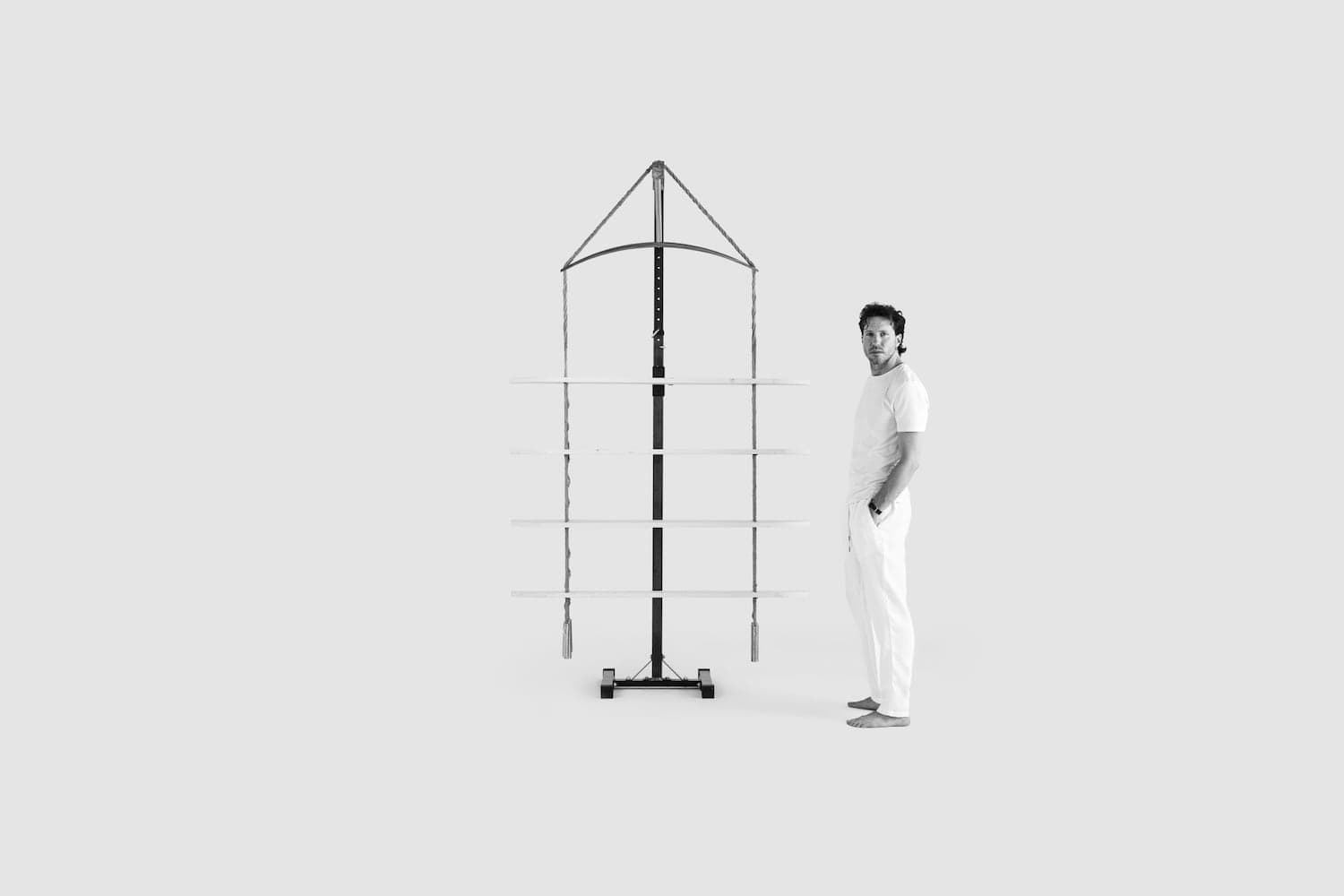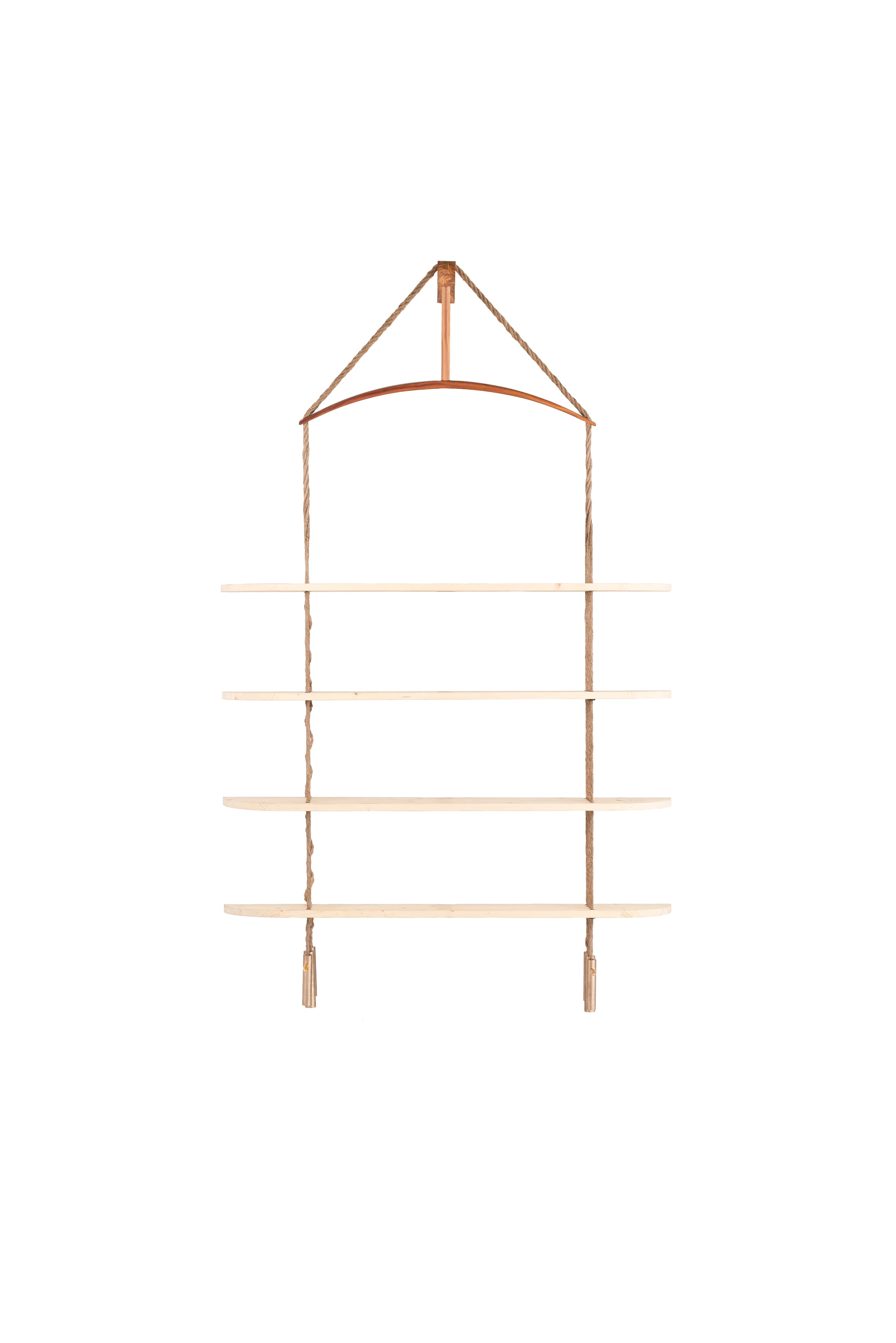
There could be no better representation of the concept expressed in The Manifesto than the first bookcase: ITACA. It is no coincidence that it tells of Ulysses' journey home, after seven long years spent on Calypso's island — the concept of nòstos thus becomes the supreme emblem of the journey of return to the cultural, social and moral role that belongs to us.
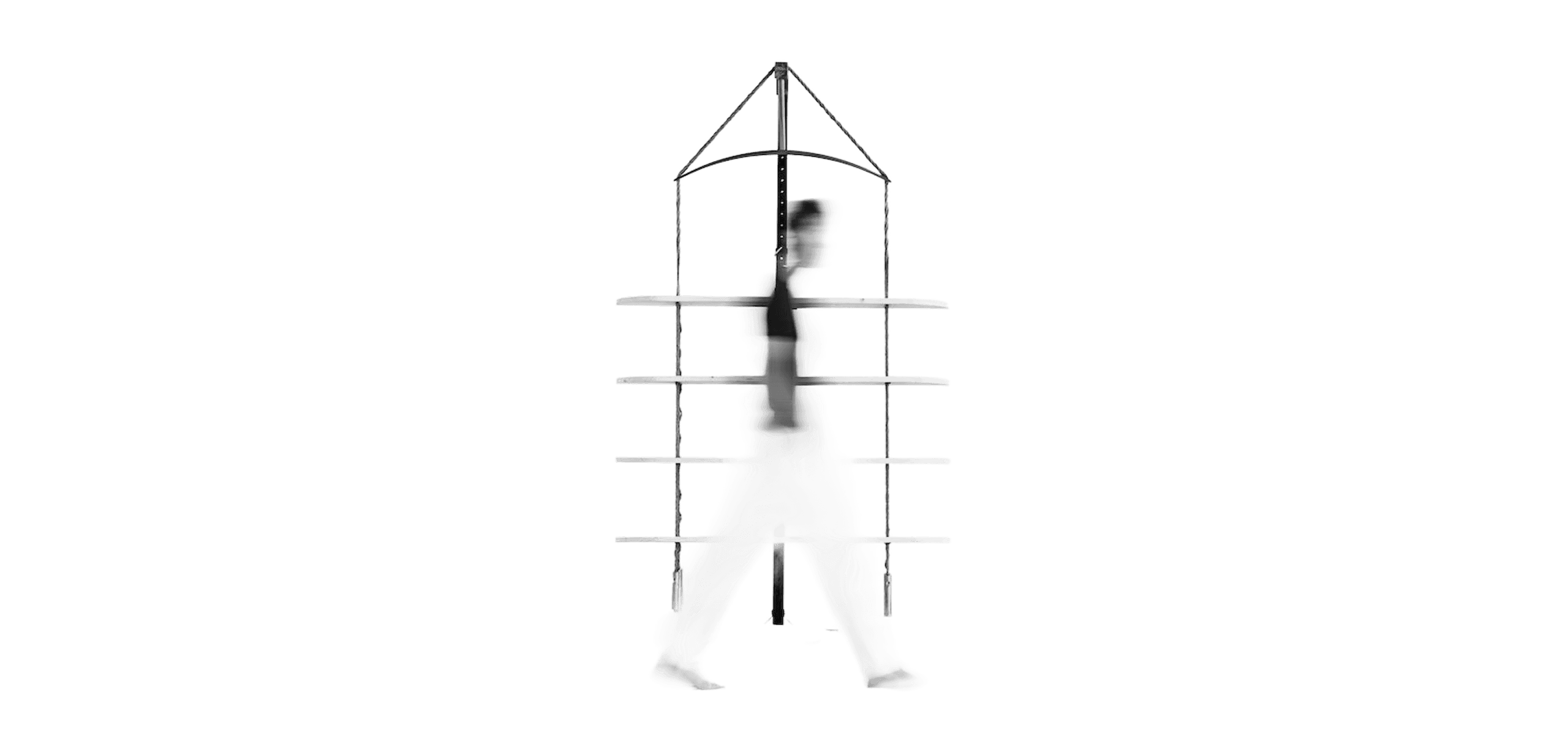
The book that inspired this bookcase is
“An Odyssey” by Daniel Mendelsohn.
I warmly recommend reading it.
Constituent Elements
The bookcase reads from the bottom up, like the journey it tells: each element is a stage of Odysseus' nòstos.
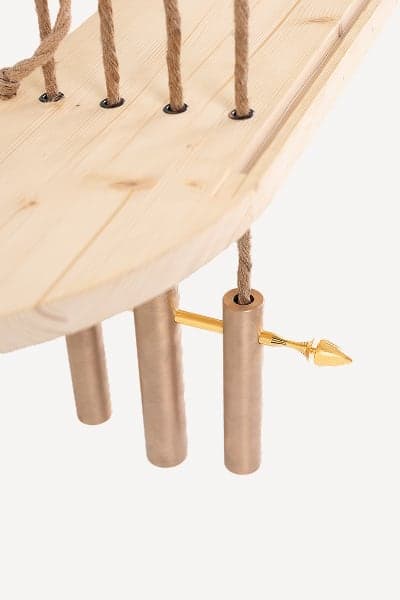
01 / 04 — Trident and Shuttle
Waiting and Captivity
The bookcase is made up of two bronze groups, arranged symmetrically at the base. Each is formed of three cylinders composing a trident, pierced through and clamped by a rod that stands for a shuttle.
The trident is a symbolic reference to Poseidon - god of the sea - who denies Odysseus his return to Ithaca after he blinded Polyphemus, the god's own son by Thoosa. Fittingly, this figure sits at the lower end of the piece, in direct opposition to the bookcase's apex, the symbol of homecoming and the journey's final destination.
The second element is the shuttle, which in turn evokes the art of weaving. The reference here is to Penelope who, to buy time while awaiting her beloved's return, tries to outwit the Suitors by promising to remarry once she has finished weaving the shroud - weaving it by day and unpicking it by night. The whole base structure plays into this allegory: the bronze cylinders recall the weights once used in antiquity to keep a loom's threads taut. Those threads are embodied here by the hemp rope, which at this junction of the bookcase splits into its constituent strands, visually recreating the image of a woven weft.
On the opposite side stands the second bronze group, a mirror of the first but with one crucial difference: its shuttle is gold. The Homeric reference is unmistakable: “...and inside, singing beautifully, she wove through the loom with a golden shuttle.” This is how Homer introduces Calypso, who counterbalances the bookcase not only structurally but narratively too: Calypso is the second dominant female figure in the Odyssey, holding Ulysses captive on her island for seven long years out of a love bordering on obsession: “I will not let you go - I keep you here with me, on my island.”
This double meaning of love - requited and hopeful on one hand, unrequited and coerced on the other - is expressed here through structural balance, held in constant tension, as we shall see, by the support beneath it.
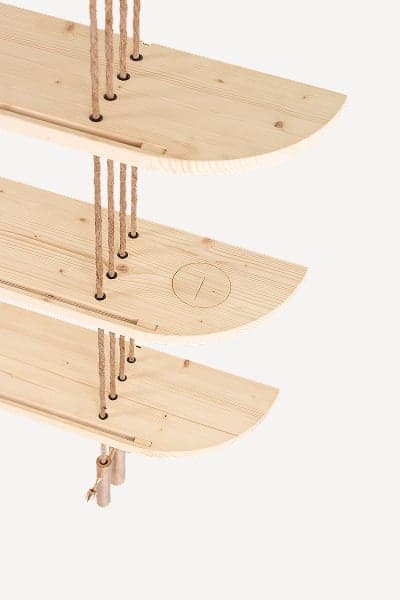
02 / 04 — Fir Shelves
The Navigation
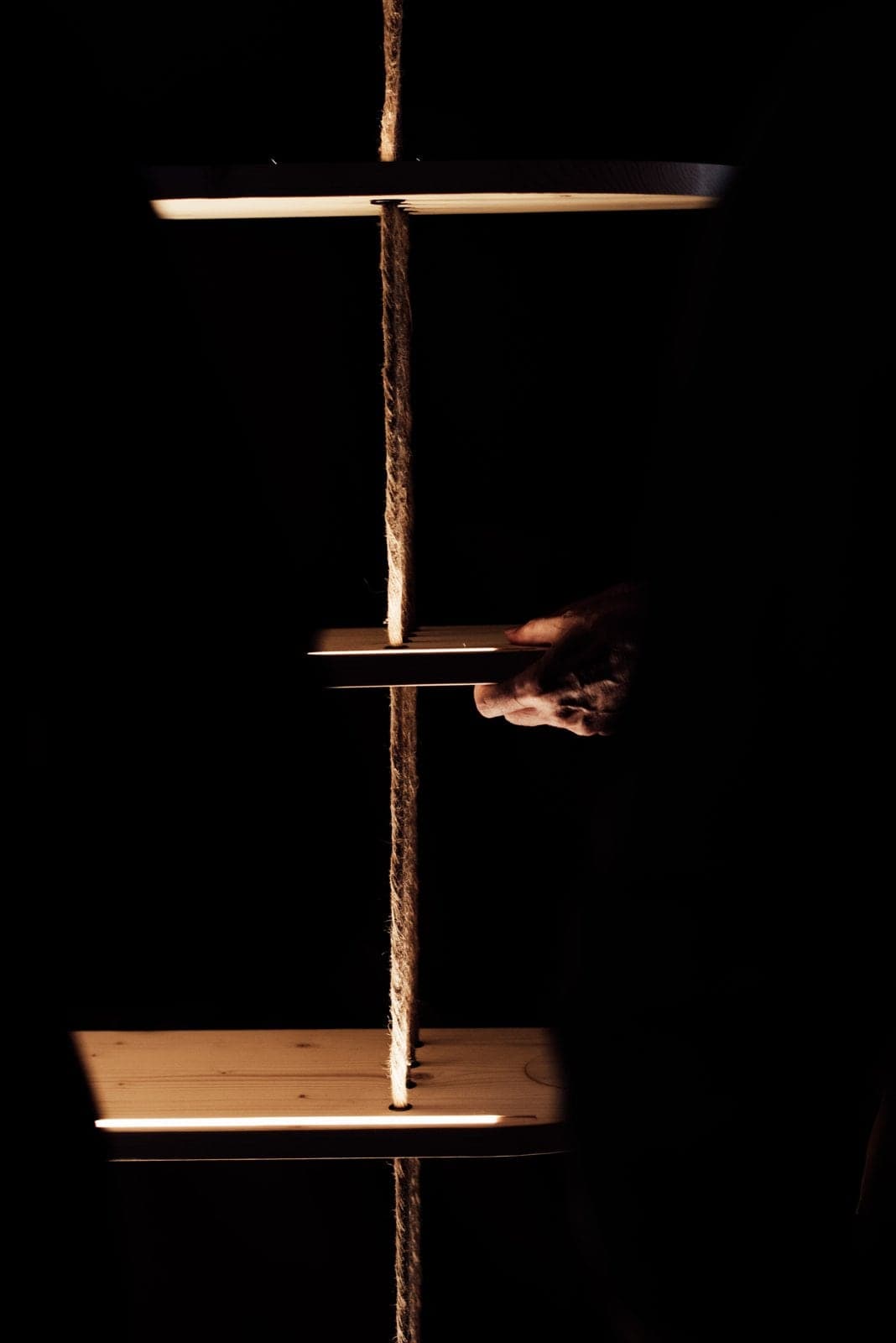
Following the weave of our journey, we arrive at the centre of the piece, where the bookcase presents four wooden boards whose shape and material embody the theme of Odysseus's sea crossing on his way home to Ithaca. Fir, in fact, was the wood most widely used in ancient Greece to build ships, while the boards' bevelled profiles echo the ribs of a hull.
This marks a shift from stability to motion: Odysseus leaves Calypso, aided by Athena's intercession, and sets out to sea once more towards his homeland. That the structure sways when unloaded - that is, without books - is a visual allegory of navigation, a reminder that without culture we are sailors adrift at the mercy of the sea.
It falls to each of us, through our own subjective and intimate life experiences, to fill these shelves with the books of our own story, so as to steady our vessel, chart a conscious course, and finally return home.
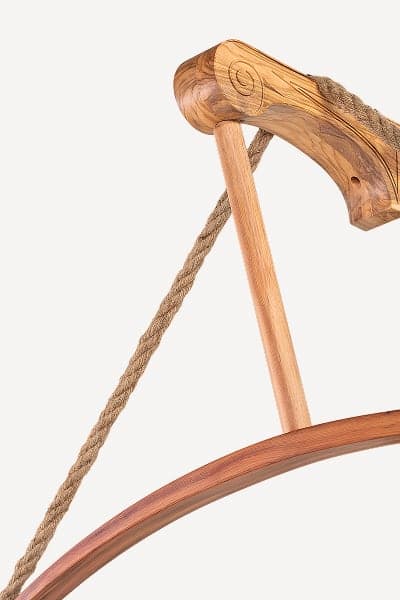
03 / 04 — Bow and Arrow
Struggle and Balance
In the upper part of the bookcase, the strands making up the rope come back together and interweave: our nòstos is drawing to a close. The bow and arrow take centre stage, an explicit reference to Odysseus's battle against the Suitors to reclaim Ithaca. The material chosen is Yew, the wood that has shaped the millennia-long history of archery.
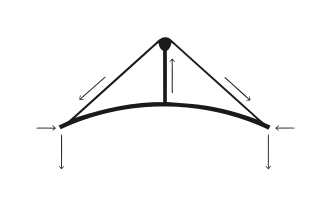
Though the hero's weapon was in truth a composite bow, here we chose to celebrate the bow's purest archetype. Yew, which by nature holds the perfect balance between tension and compression, becomes the ideal manifesto for this structure. Yet a further consideration underlies this design: had the wood been straight, the load on the structure would have stretched the hemp rope through elastic deformation, causing the “arrow” element to give way and compromising its structural role.
The curved form is thus the result of an innovative and rigorous engineering calculation, designed to balance the forces at play. And is this not, in essence, the very same trial Odysseus faced on his return home? Rather than surrender to the pull of emotion, the hero had to weigh the forces before him, master his feelings, and draw on the skills honed over his long voyage - cunning, composure and calculated action - to win back his land and his beloved.
04 / 04 — The Support
The Nòstos
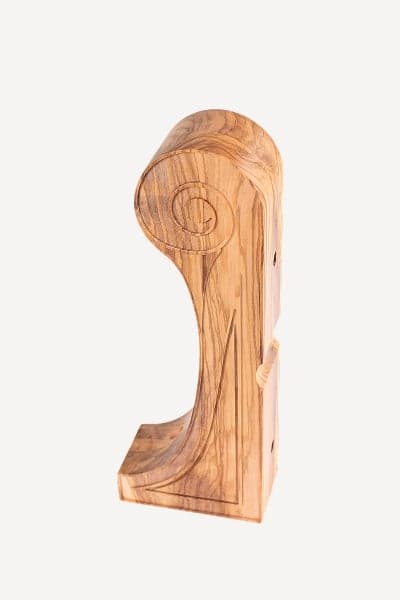
The final element, supporting the entire structure, takes the form of an ancient bed leg, standing for the celebrated marriage bed that Ulysses built by carving it from an olive tree.
It is through this secret — guardian of their deepest and most inviolable intimacy — that Penelope at last recognises her husband. This single load-bearing element also alludes to the boundless willpower Ulysses had to summon to overcome every trial his homeward journey set before him, and to return to his beloved — the ultimate embodiment of a love that sustains and guides.
So closes the material climax of the bookcase: after Fir for the voyage and Yew for the struggle, Olive marks the stability regained. There is no more sea to brave, no more time to chase: the nòstos of Ulysses, like our own, ends here.
Engineering of Balance
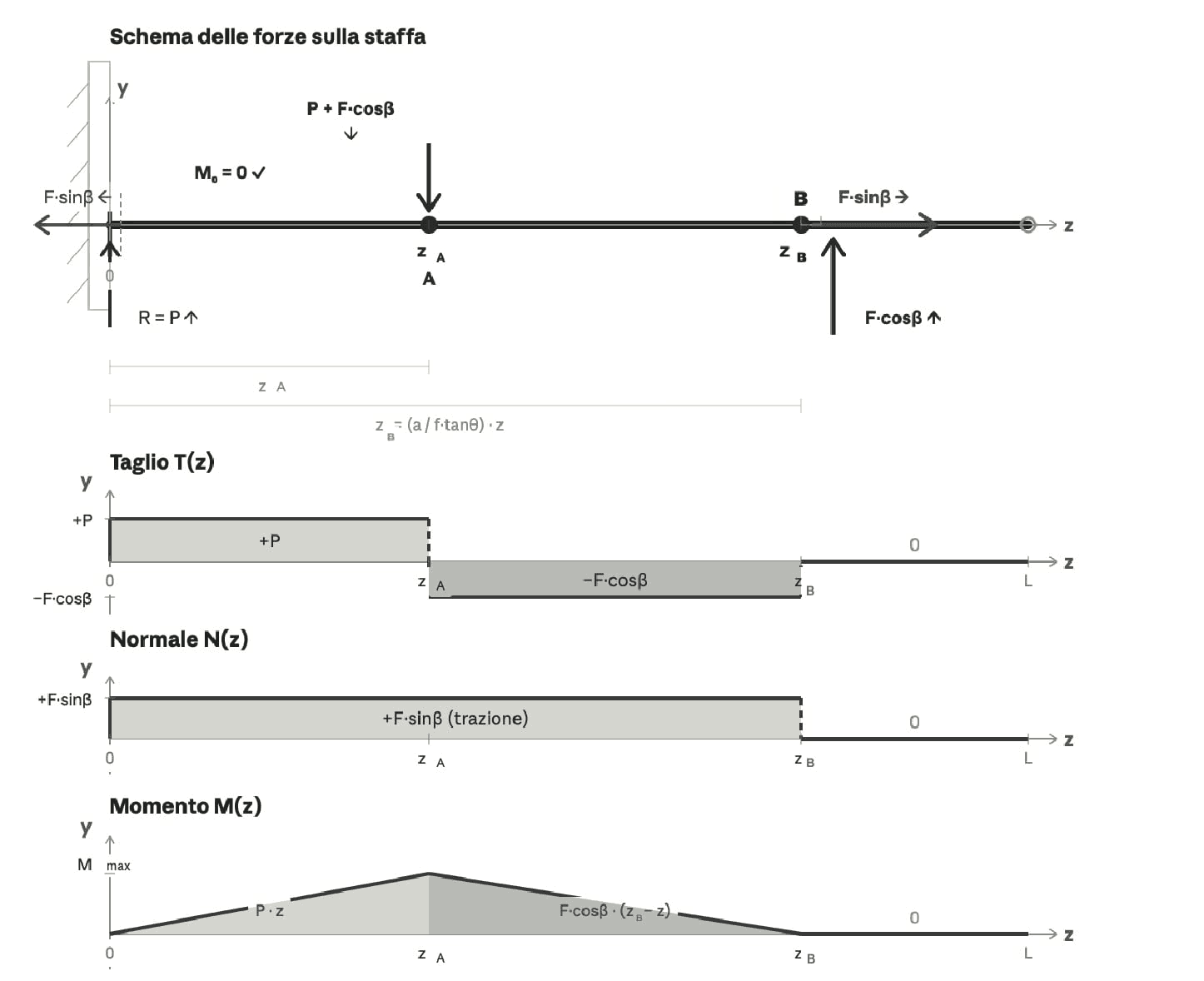
The bow and arrow elements do not serve a narrative purpose alone: they form a complex structural node. Through a precise redistribution of the acting forces, the curved geometry cancels the bending moment on the wall joint, ensuring an anchorage of exceptional safety and stability.
This solution, unprecedented in furniture design, has been the subject of a patent filing to protect its innovative function.